Real estate growth
Local SEO for real estate: a practical starting plan
Local visibility starts with the places you actually serve and the questions you can answer well. Build from that evidence, not a list of town names.
Start local SEO for real estate with the areas you actually serve, accurate business information and pages that answer local customers' questions. Someone looking for an agent wants to know whether you work in their area and can help with their type of property or transaction.
Local SEO connects that question with a credible business profile and useful website pages. It cannot move your office closer to every searcher or guarantee a position in the map results. This plan focuses on the information and enquiry journey you can improve.
Choose the areas and services you can support
Begin with a short service map: the locations you genuinely cover, the types of clients you can help and the services available in each place. Use your business records and team knowledge. A long keyword list is not evidence that you have a meaningful presence in every town on it.
For an illustrative agency serving two neighbouring districts, the useful starting point might be one sales page and one lettings page for each area, backed by actual staff and local information. Another agency may be better served by one strong district guide and clearly described service coverage. Page count is not the goal.
Record a practical reason for each proposed page: a distinct service, a different audience or enough location-specific knowledge to answer a real question. If only the place name changes, combine the material until there is something useful to say.
Make the business information accurate
For an eligible business, check its Google Business Profile against the real business: name, category, contact details, opening hours and the correct website destination. Google's local-ranking guidance describes relevance, distance and prominence as important factors. Complete information helps Google understand the business; it does not let you buy a better organic local position.
Real estate agents may also fall under Google's individual-practitioner rules. Check eligibility before creating separate agent or location profiles. Do not create an invented office address or add extra keywords to the business name simply to target a search.
Keep an ownership record for the profile and related accounts. Access should not depend entirely on a former employee or a supplier's private account.
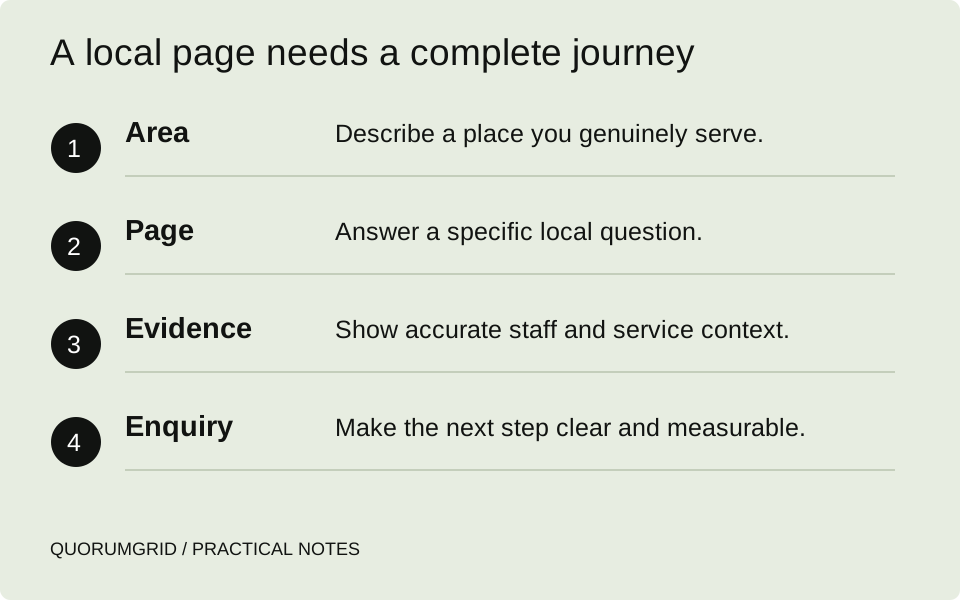
A local page needs a complete journey
- Area
Describe a place you genuinely serve.
- Page
Answer a specific local question.
- Evidence
Show accurate staff and service context.
- Enquiry
Make the next step clear and measurable.
What a useful area page could contain
Here is an illustrative page brief, not a claim about an existing Fusion client: a residential agency wants to help owners considering a valuation in its actual service area.
- Who the page helps: owners deciding whether to request a valuation.
- Local evidence: an introduction by the relevant team, representative property types and links to available listings where permitted.
- Decision details: what the valuation involves, what information the owner should prepare and how the agency follows up.
- Useful context: dated local observations with their source, rather than unsupported claims that prices always rise.
- Next step: one clear valuation or contact route, with an explanation of what happens after submission.
Keep the content accurate when staff, services or property availability changes. Avoid presenting an old listing as current evidence without its status. Broader buying or legal advice should be reviewed by a suitably qualified person for the relevant market.
Connect the pages a visitor needs
A local guide should lead naturally to the relevant service, available properties and a contact route. Link from the main service area navigation so the page is discoverable, rather than leaving it as an isolated URL that only appears in a sitemap.
For a property site, check that a visitor can move from an area page to a listing and back without losing their place. An enquiry should carry enough context for the team to understand which property or service prompted it. Do not put unnecessary personal details into analytics events.
If the page already attracts visitors but few enquiries, that is a different problem from being invisible in search. Use our real-estate enquiry guide to inspect the information and contact journey before commissioning more location pages.
Build evidence that can be checked
Give staff biographies, service descriptions and photographs a clear connection to the real business. Request genuine feedback through an appropriate, consistent process and check the platform's current policies. Invented reviews and stock staff portraits do not establish a local reputation.
Local references can also be useful when they reflect actual activity: a professional association listing, a local event or an editorial mention. A directory submission package with no relevance to the business is a different proposition. Ask what a proposed listing contributes for a real customer.
For published market numbers, include the source and period. If your team has only an observation, describe it as an observation. An honest local explanation is more useful than a precise statistic nobody can substantiate.
Use a small measurement sheet
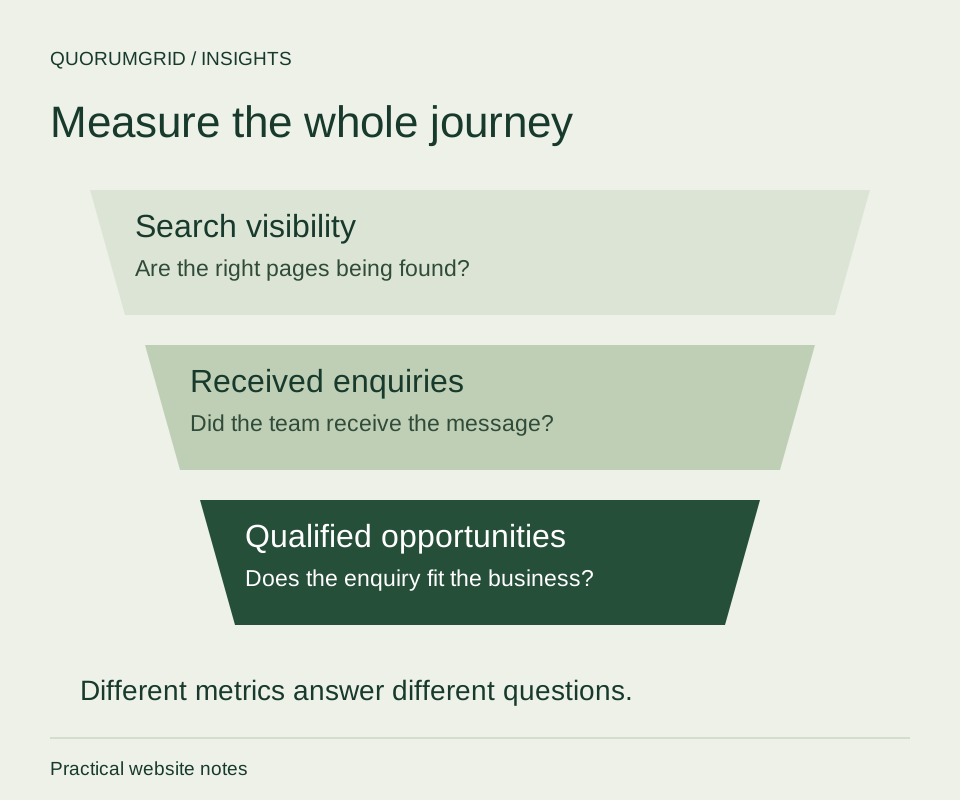
Track the area page, the queries that bring it impressions and clicks, and the enquiries your team accepts. In the enquiry record, note the requested service and whether the business can help. A large traffic increase outside your service area may have little commercial value.
One simple monthly review asks: which local questions appeared, which useful pages were visited, which enquiries arrived and where the journey broke? Compare like-for-like periods where practical and note changes in listings, seasonality or campaigns. Do not attribute every new lead to one article.
Choose the next improvement from those observations. It might be a missing service explanation, an inaccurate profile detail or a form that needs attention. Publishing another ten town pages is only useful when those pages answer ten distinct needs.
A manageable first pass
- Check one real business profile and correct inaccurate contact, hours or service details.
- Choose one area/service page and improve the information a local customer needs to decide.
- Try its enquiry route on mobile using your own contact details and clearly mark the message as a test. Keep that test out of real-enquiry counts, then record the starting search and enquiry observations for comparison.
Review those changes before expanding the page list. This gives the team a small, observable piece of work rather than a publishing target with no customer purpose.
Sources and further reading
Technical references for this guide. The checklists and examples are our practical recommendations, adapted to the subject.