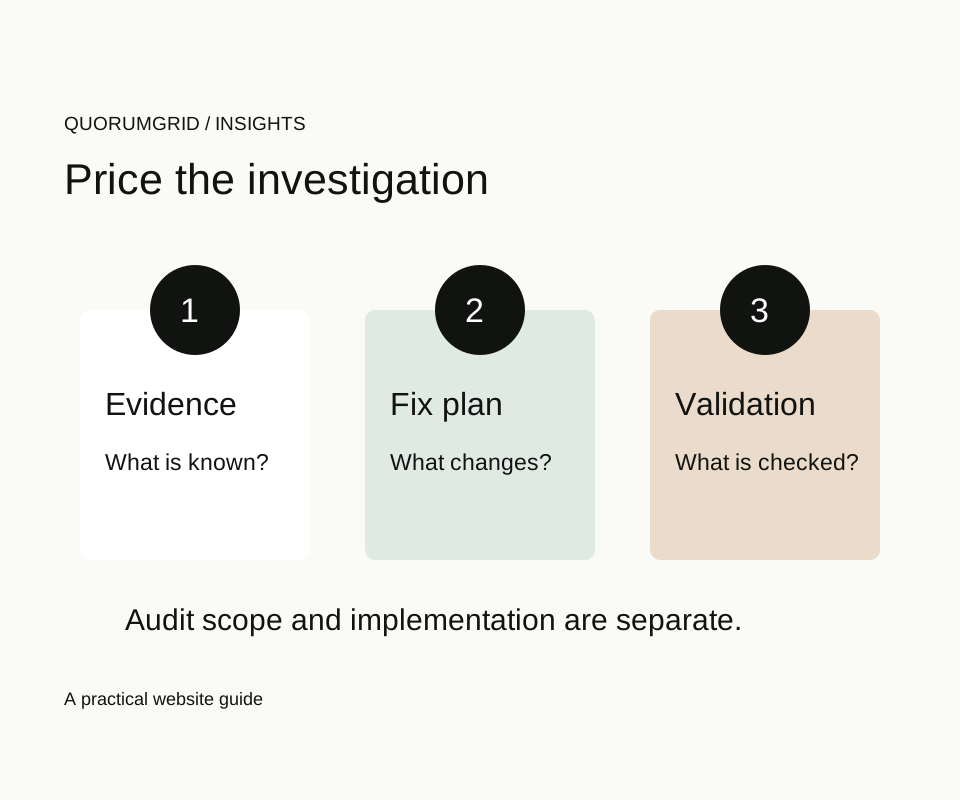
SEO resources
An SEO audit report sample you can actually use
A useful report helps the next person make a change and check the result. This labelled example shows the level of detail to ask for.

Use the SEO audit report sample below to see how an observation becomes an assignable finding: evidence, priority, an owner and an acceptance check. There is also a blank worksheet you can download and adapt for your own review. A score or a long export alone does not tell the team what should change first.
The sample below is entirely illustrative. The business, URLs and findings are invented to demonstrate a reporting method. We have not inspected a client behind these examples, and the numbers are not results achieved by QuorumGrid.
Open with the question and the limits
For this example, imagine a small home-services business whose repair page is important to enquiries. The agreed question is whether a recent template change made that page harder for search engines to index. The review covers the homepage, main service template, contact journey and a sample of supporting pages.
The report should name the review date, the pages inspected and the evidence available. In our example there is no historical conversion record, so the author cannot calculate lost sales. That limitation belongs near the conclusion, not hidden in an appendix.
A real report should also distinguish production observations from staging tests. A staging-only warning is not proof of a live indexing failure. Likewise, a clean homepage check does not establish that every service page behaves correctly.
Sample finding: an important page carries noindex
Illustrative finding F-01, not a real client audit
Affected example: /services/boiler-repair
Observation: the example page returns HTTP 200, but its HTML contains <meta name="robots" content="noindex">.
Reader/business relevance: this is a main service page the business intends to make available in search.
Confidence: reproduced in the illustrative source response. The reason the directive was added still needs investigation.
Recommendation: confirm the page is intended for search, remove the unintended directive from the responsible template or setting, and verify the rendered response after cache invalidation.
Owner: the developer responsible for the template, with business approval of indexing intent.
Acceptance: the intended production response no longer contains the directive in HTML or headers; the page is accessible; a subsequent search inspection is recorded separately.
Google's noindex documentation explains the directive. Removing it makes indexing possible when other requirements are met; it does not guarantee indexing or a position in results.
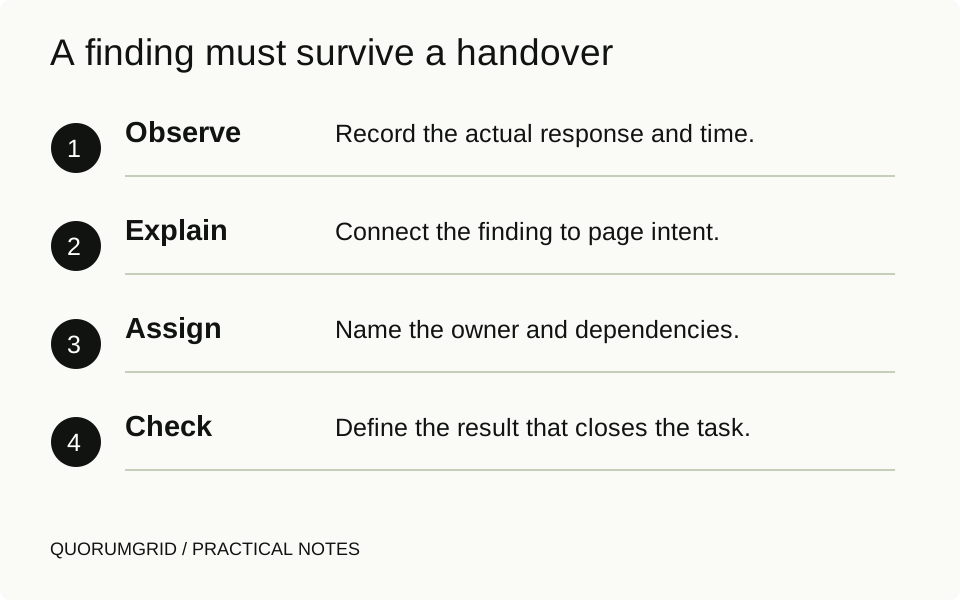
A finding must survive a handover
- Observe
Record the actual response and time.
- Explain
Connect the finding to page intent.
- Assign
Name the owner and dependencies.
- Check
Define the result that closes the task.
Capture enough evidence to reproduce the claim
In a real investigation, save the URL, time, response status, relevant header or HTML excerpt and the method used to inspect it. Redact tokens and personal information. A screenshot of a crawler warning without an affected example gives the developer too little to work with.
The finding should also record scope. Was the directive found on one page, on every page of the same template or only in a crawler's old cache? Sample the affected pattern before assigning a site-wide repair. If it cannot be reproduced, preserve that uncertainty.
For a question involving Google's stored state, distinguish URL Inspection's indexed information from a live page check. They answer different questions. A fresh HTTP response cannot establish what Google currently has indexed.
Explain the priority instead of using red labels everywhere
For the illustrative repair page, unintended noindex deserves early attention because the page is important and the evidence is direct. That does not make every noindex directive a defect. A private account page or filtered result may intentionally be excluded.
Describe impact, confidence, affected scope and dependencies. A suspected issue on a low-value archive may deserve investigation rather than the same urgency as a confirmed problem across the primary service template.
A practical order could be: confirm intent, correct the responsible setting, verify the served page, then review Google's subsequent processing. Content expansion belongs later if the page is still explicitly telling search engines not to index it.
A reusable finding worksheet
Download the editable audit finding worksheet (TXT). It contains blank fields and completion prompts, not pre-filled findings. Open it in a text editor or copy it into your reporting tool; replace prompts with your own observations and keep unverified items clearly marked.
Copy these fields into the reporting tool your team already uses. The purpose is to make a finding assignable and reviewable, not to require another dashboard.
- Identifier and question: what are we trying to establish?
- Affected URL or template: where can the issue be inspected?
- Observed evidence: what happened, when and by which method?
- Impact and confidence: why it matters and what remains uncertain.
- Recommended action: the smallest useful correction.
- Owner and dependency: who can act and what approval or access is needed?
- Acceptance check: what result closes the technical task?
- Outcome follow-up: which later search or enquiry observations will be reviewed?
For a content finding, the evidence might be a mismatch between a service page and the actual enquiry questions. Do not force every useful observation into a technical error code.
End with an implementation conversation
Separate corrections the team can make now from work that needs discovery or a quote. Ask the implementer to confirm the proposed acceptance checks before beginning. That reduces the risk of paying for a change that does not address the original finding.
Keep completion and business outcome separate. A corrected directive can pass its technical acceptance check while search performance remains unchanged. Record both facts rather than keeping a fixed task open until an uncontrollable ranking target is reached.
Use our audit cost guide to agree whether implementation and follow-up are included in a proposal. If you want to perform the investigation itself, the technical audit checklist covers a sensible checking order.
Sources and further reading
Technical references for this guide. The checklists and examples are our practical recommendations, adapted to the subject.